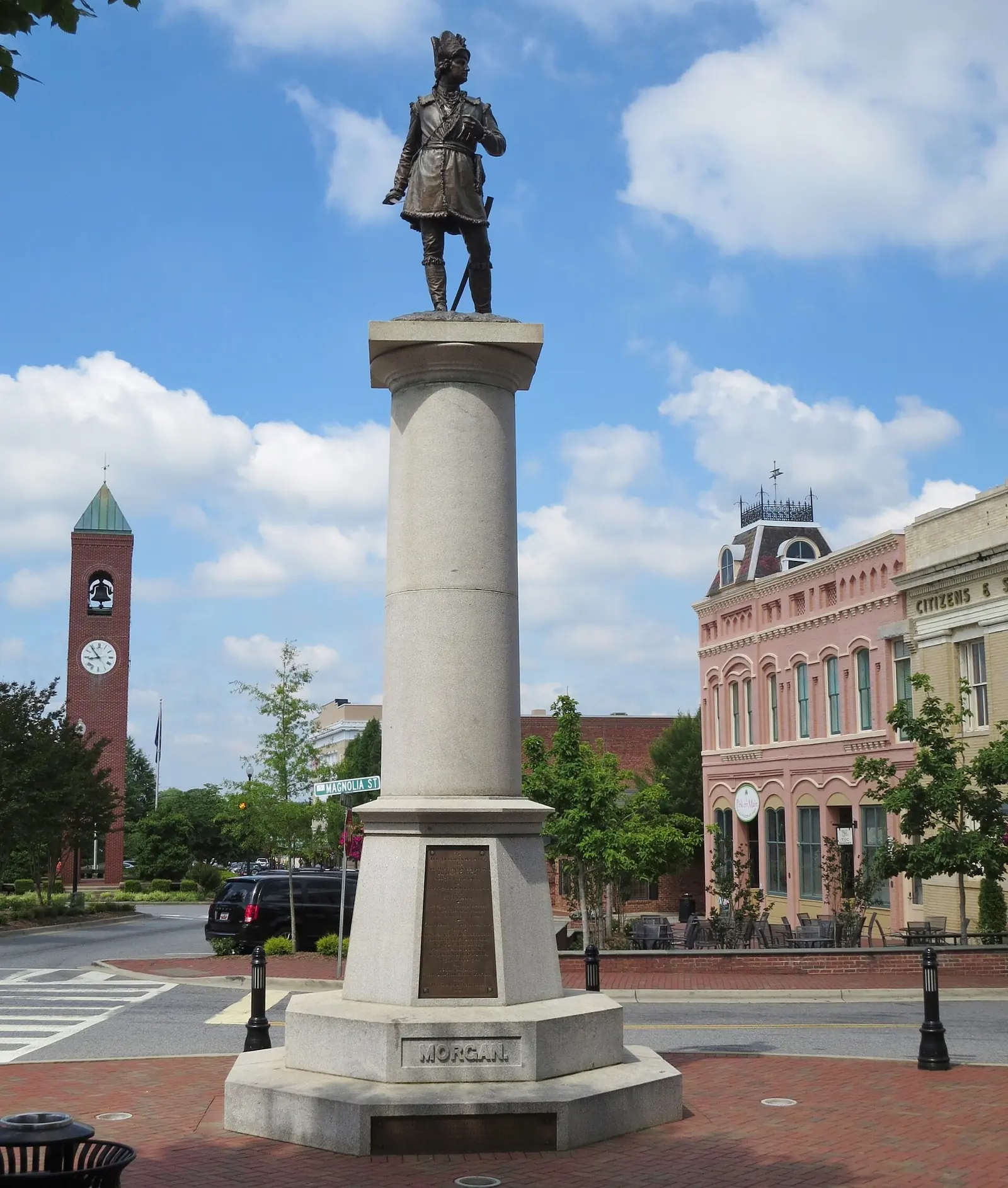
Spartanburg was incorporated in 1831 around what became Morgan Square. Its National Register listings, from Wofford College to the Montgomery Building.
Last checked Oct. 12, 2026. Facts on this page come from the South Carolina Encyclopedia (University of South Carolina), the National Park Service’s National Register of Historic Places data (May 2026 release), the City of Spartanburg’s Historic Districts and Southside Cultural Monument pages, and Spartanburg County Historical Association, 864-576-6546.
Spartanburg grew from a county seat chosen in 1789, when Spartanburg County officials picked a spot for a courthouse and jail on Williamson’s plantation in the center of the county. The town was incorporated in 1831 and took its name from a local Revolutionary War regiment, the Spartan Rifles, according to the South Carolina Encyclopedia. It was laid out around an open rectangle that became Morgan Square after a statue of Revolutionary War hero Daniel Morgan was put up there in 1881.
Who to call
- Spartanburg County Historical Association (Walnut Grove, Price House, Seay House): 864-576-6546, info@spartanburghistory.org
- City historic districts and design review: Planning Department, 864-596-2068
- Hub City Railroad Museum: 864-278-4453
Timeline
| Year | What happened |
|---|---|
| 1789 | County officials choose the courthouse site |
| 1831 | Town of Spartanburg incorporated |
| 1854 | Wofford College opens, from a bequest of Methodist minister Benjamin Wofford |
| 1859 | The Spartanburg and Union, the town’s first railroad, arrives |
| Sept. 1865 | Freed people gather by a spring on the south side for the city’s first emancipation celebration |
| 1881 | Daniel Morgan statue goes up on the square |
| 1888 | Spartan Mills, the first mill in the city limits, is built |
| 1889 | Converse College is founded |
| 1912 and 1923 | The Chapman Building and the Montgomery Building rise as the city’s first skyscrapers |
| 1917 | Camp Wadsworth opens for World War I training |
| 1927 | Spartanburg’s airport opens as South Carolina’s first commercial airport with airmail |
| 1930 | WSPA, the state’s first commercial radio station, goes on the air |
| 1940 | Camp Croft opens just outside the city |
| 1970 | Spartanburg integrates its schools peacefully |
Sources: the South Carolina Encyclopedia, the city’s airport history and the Southside Cultural Monument text.
The city’s Southside Cultural Monument marks the gateway to the south side and honors African American leaders including educator Mary H. Wright, born into slavery in 1862, who taught in Spartanburg for most of a 65-year career; Dr. T.K. Gregg; and Joseph and Priscilla Young, who made the city’s “Freedom Flag” in 1865, the city’s monument page says.
National Register of Historic Places in Spartanburg
These listings are inside or at the edge of the city, with the date each was listed, from the National Park Service’s register data:
| Listed | Property | Address |
|---|---|---|
| July 16, 1970 | Evins-Bivings House | 563 N. Church St. |
| Dec. 18, 1970 | Foster’s Tavern | 191 Cedar Spring Road |
| Oct. 7, 1971 | Jammie Seay House | Darby Road off Crescent Avenue |
| April 13, 1973 | Cleveland Law Range | 171 Magnolia St. |
| Dec. 27, 1974 | Wofford College Historic District | Wofford College campus |
| Nov. 12, 1975 | Converse College Historic District | 580 E. Main St. |
| Sept. 22, 1980 | Daniel Morgan Monument | Main and Church streets |
| Jan. 27, 1983 | Hampton Heights Historic District | Spring, Henry, Hydrick and Peronneau streets area |
| May 19, 1983 | Spartanburg Historic District (expanded 2000) | West Main, Magnolia, Wall, Ezell and Spring streets |
| Nov. 1, 1984 | Walter Scott Montgomery House | 314 S. Pine St. |
| April 12, 1996 | Palmetto Theater | 172 E. Main St. |
| May 26, 2000 | Church of the Advent | 141 Advent St. |
| Oct. 24, 2000 | Fremont School | 600 Magnolia St. |
| April 10, 2001 | Hotel Oregon | 247 and 249 Magnolia St. |
| April 11, 2003 | Alexander House | 319 E. Main St. |
| April 18, 2003 | American Legion Building | 94 W. Park Drive |
| Oct. 3, 2003 | Central Methodist Church | 233 N. Church St. |
| Oct. 4, 2005 | Arcadia Mill No. 2 | 100 W. Cleveland St. |
| March 21, 2007 | Evans-Russell House | 716 Otis Blvd. |
| Aug. 3, 2007 | Mary H. Wright Elementary School | 201 Caulder Ave. |
| Sept. 25, 2007 | Converse Heights Historic District | Clifton, Otis, Palmetto and nearby streets |
| Oct. 2, 2009 | Bishop William Wallace Duncan House | 300 Howard St. |
| May 25, 2011 | Montgomery Building | 187 N. Church St. |
| June 27, 2012 | Frank Evans High School | 142 S. Dean St. |
| Oct. 24, 2012 | Drayton Mill | 1802 Drayton Road |
| May 12, 2014 | Schuyler Apartments | 275 S. Church St. |
| Sept. 30, 2014 | Arcadia Mill No. 1 | 1875 Hayne St. |
| Oct. 5, 2015 | Converse Mill | 200 High St. |
| Jan. 26, 2016 | Duncan Park Stadium | West Park Drive |
| Oct. 17, 2016 | Pine Street Elementary School | 500 S. Pine St. |
| Jan. 31, 2017 | U.S. Post Office and Court House | 201 Magnolia St. |
Outside the city but with a Spartanburg address, the register also lists Walnut Grove Plantation (1970), the Nicholls-Crook House (1973), Walker Hall (1977), Anderson’s Mill (1978) and the Golightly-Dean House (1988).
Local historic districts
The city protects two neighborhoods as local historic districts, with design review for exterior changes, according to its Historic Districts page:
- Hampton Heights: 375 homes built from 1890 to 1930 in Queen Anne, bungalow, Craftsman, foursquare and neoclassical styles.
- Beaumont Mills: the mill village around the Beaumont Manufacturing Company, founded by J.H. Sloan in 1890; designated a local district April 11, 2011.
Museums and historic sites to visit
- Hub City Railroad Museum, in the historic Southern Railway depot at 298 Magnolia St.: open Wednesday and Saturday, 10 a.m. to 2 p.m., per its website.
- Spartanburg Art Museum: Tuesday through Saturday, 10 a.m. to 5 p.m., free; closed for installation until Oct. 15, 2026, its website says.
- Walnut Grove Plantation, the Price House and the Seay House, run by the Spartanburg County Historical Association. Call 864-576-6546 for visiting times.
- Morgan Square and the Daniel Morgan Monument, downtown.
What this means for you
- Start on Morgan Square, then walk Magnolia Street for the depot, Hotel Oregon and the old post office.
- Hampton Heights and Converse Heights make good self-guided walks.
- Planning exterior work on an old house? Check whether it is in a local historic district first.
More guides: population and growth, parks and trails and building permits and zoning.
Frequently asked questions
When was Spartanburg founded?
County officials chose the site for a courthouse and jail in 1789, on Williamson’s plantation in the center of the county, and the town of Spartanburg was incorporated in 1831, according to the South Carolina Encyclopedia.
How did Spartanburg get its name?
From a local Revolutionary War regiment, the Spartan Rifles, the South Carolina Encyclopedia says.
Why is it called Morgan Square?
The town was built around an open rectangle that became known as Morgan Square after a statue of Revolutionary War hero Daniel Morgan went up there in 1881. The monument was listed on the National Register of Historic Places in 1980.
How many National Register sites are in Spartanburg?
The National Park Service’s register lists 38 entries with a Spartanburg address, including districts, boundary changes and several rural sites outside the city. More than 25 are inside or at the edge of the city.
Have your say