AIB wants to build three more data centers at Tyger River Industrial Park North, with $39 million in community payments. Two more council votes are needed.
The company behind one of Spartanburg County’s newly approved data centers wants to build three more. Spartanburg County Council gave the three plans their first reading Monday, Nov. 16.
All three would go up at Tyger River Industrial Park North. Each comes with a development agreement and a tax-credit agreement. Together, the three development agreements promise:
- $39 million in community payments over 15 years
- at least 150 full-time jobs, 50 at each site
- about $6.87 billion in total investment by the companies and their tenants
The drafts were added to the council’s final agenda packet for Nov. 16 as Economic Recruitment and Development Committee items B, C and D.
The committee and then the full council approved each by voice vote, with no audible opposition, the county’s meeting video shows. The same night, council gave final approval to AIB’s first project, at 389 Tyger River Industrial Drive. Read our story on that vote.
The three projects
| AIB CLT2 | AIB CLT3 | AIB CLT4 | |
|---|---|---|---|
| Size | 65 IT megawatts | 50 IT megawatts, 65 megawatts maximum | 50 IT megawatts, 65 megawatts maximum |
| Land | about 45 acres | to be set by survey | to be set by survey |
| Company investment, at least | $900 million | $690 million | $1.106 billion |
| Total investment anticipated | $2.706 billion | $2.081 billion | $2.081 billion |
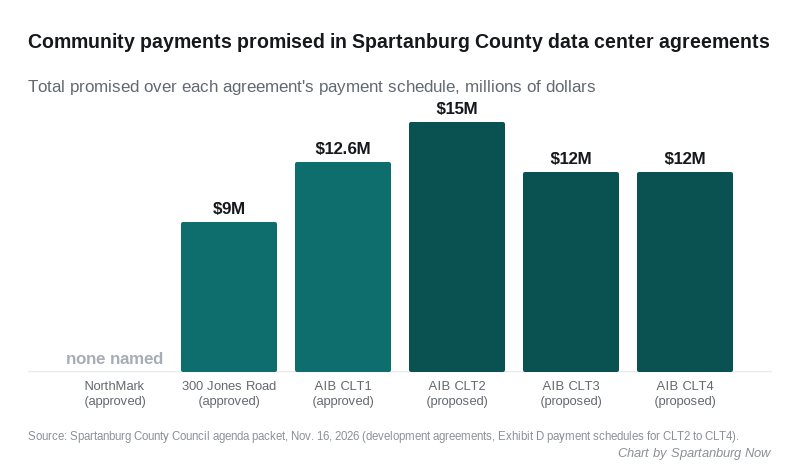
| Community payments | $15 million | $12 million | $12 million |
| Jobs, at least | 50 | 50 | 50 |
Each development agreement runs for 40 years. Construction must start within a year of the last county approval, or once any legal challenges are settled. Each project must be substantially complete within five years.
An AIB representative told council that one building would go on Lot 2 of the park at 65 megawatts, and two on Lot 3 at 50 megawatts each. Each would be a single-story building about 30 feet tall at the roof’s edge, 36 feet at its highest point, the representative said.
Fuel cells, not turbines
Each agreement allows on-site power generation, including solid oxide fuel cells. The CLT3 and CLT4 drafts name Bloom Energy as the maker.
“Nothing is burned. So there is no flame, no engine and no turbine,” the AIB representative told council. The representative said all three buildings would use closed-loop systems. Each would use about 65,000 gallons of water a year, for restrooms, a break room and fire sprinklers.
The agreements also allow backup generators, battery storage and an electrical substation on each site.
How the community money works
Each project pays $1 million within 30 days of its tax-credit agreement being approved. It pays $500,000 more within 30 days of getting all its development approvals. That is $4.5 million across the three before any building opens.
After that, the payments are yearly through year 15:
- CLT2: about $964,286 a year, for $15 million in all
- CLT3 and CLT4: $750,000 a year each, for $12 million apiece
The money goes to a community foundation or similar public charity. The county decides how it is spent, from a list that includes:
- workforce training and scholarships
- STEM programs and education partnerships
- broadband
- affordable housing
- parks, trails and land and watershed conservation
- road improvements
The company can veto a proposed use that is not in line with its “values or beliefs.” If the two sides cannot agree, the county may still go ahead with a use on the list. The agreements call the payments “voluntary charitable commitments,” not a tax or fee.
The tax-credit side
The three ordinances also approve “special source credit” agreements. These cap the yearly payment each project makes in place of property taxes for 40 years. The cap amount is left blank in the drafts.
The first-reading drafts have other gaps. The draft ordinances and tax-credit agreements for CLT3 and CLT4 repeat CLT2’s investment figure of at least $2,705,541,607. The tax-credit drafts also describe a 65-megawatt facility. Their own development agreements say $2.081 billion and 50 megawatts. The property address is blank in each ordinance.
The drafts say the projects fall under the exemptions in the county’s data center moratorium.
What happens next
Each agreement needs a second and third reading and a public hearing before it is final. The county had not posted dates for those by Tuesday.
What it means for you
- To read the drafts: they are in the Nov. 16 agenda packet, after the agenda’s committee items.
- To follow the votes: the county posts agreements and results on its data center information page.
- To speak: the public hearing will come at a later reading. Agendas go up in the county’s Agenda Center ahead of each meeting.
Have your say